Visitors

Saturday, 2 March 2019

Daily Diary (DD) - Day 61 of 2019

0246hrs: Update from Sialkot (Pakistan) and adjacent to Jammu province of J & K, on the working boundary
- Heavy exchange of fire here too.
- According to AJK Information Minister Mushtaq Minhas, 8 people have been killed and 20 injured along the LOC in AJK.

0300hrs: From Kotli
DHQ (District Headquarters Hospital) Kotli is appealing for blood donors.

0352hrs: From Bhimber Sector
Locals are hearing sounds of heavy fire, such that they've never heard before.
- Meanwhile, it appears that there is an unusual lapse in media coverage tonight, which can easily be described as the heaviest round of fighting since the current version of this un-necessary conflict began.

0457hrs: From Kotli Sector
Heavy shelling continues in tehsil Nikyaal and Tattapani. Civilian casualties are being brought to DHQ Kotli.

0700hrs: From Poonch Sector
It is reported that 300 people comprising of 60 households have left their homes in Mankote.
- It is reported that the Pakistani army checkpost in Battal is preventing locals from leaving the area. Apparently, they had been given an opportunity to leave earlier but - according to the Pakistani army - now they had to stay put.

0700hrs: From Kotli Sector
Whilst firing has been almost continuous throught the night from the working boundary (in Jammu) to Kel in Neelam, it appeared most damaging in Kotli. 

1200hrs: From Kotli Sector
O (-) negative blood group is urgently sought at DHQ Kotli
Contact:  Sardar Osama - 03450502806 / Azhar Choudhary - 03401541040

1251hrs: From Muzaffarabad
According to DC Badar Munir, 58 individuals  (mostly women and children) have arrived from areas around the LOC near Chakothi. They are staying with their relatives but the AJK administration is providing them mattresses and other necessary items, we are led to understand.

1400hrs: From Hattian Bala
Temporary camps have been erected at the AJK University campus here to accomodate those fleeing from the Line of Control. An eye-witness of the camps explains that 360 people have been adjusted in 3 classrooms. They consist of women and children but each sack-like blanket provided has to be shared between 6 people. The AJK administration explains that it is short of funds (isn't that forever the refrain?).

1655hrs: Back to base in Dadyaal

So, it has taken me many hours of combing through data over the past couple of days, to establish a set of events that give us some idea of the damage done to us, as opposed to the damage India and Pakistan inflict on each other in our territory. Despite that, we still lack detail and accuracy.

Role of Civil Society in AJK:

We have discussed data collection of casualties by local correspondents in each tehsil (subdivision) adjoining the LOC, on a number of occasions.

However, as our people have been trained to be reactive rather than proactive over the decades - if not centuries - we are always more likely to witness ad hoc behaviour rather than a consistent institution-building process here.

For the sake of posterity (once again), here's a proposed structure:

- There should be at least one correspondent in each tehsil adjoining the LOC. Of the 32 tehsils, half of them (16) can count in this description:

From north to south:
1) Sharda
2) Athmaqam
(both in district Neelam)
3) Leepa
4) Hattian
(both in district Hattian Bala)
5) Bagh (in the district of the same name)
6) Haveli
7) Khursheedabad
8) Mumtazabad
(all 3 in district Haveli)
9) Abbaspur
10) Hajeera
(both in district Poonch)
11) Kotli
12) Nikyaal
13) Khuiratta
14) Charoi
(all 4 in district Kotli)
15) Smaahni
16) Barnaala
(both in district Bhimber)

Important details to collect by correspondents:

1) Name:
2) Father's name:
3) Address:
4) Gender:
5) Age:

For anybody affected by LOC cross-firing leading to:
i) Death
ii) Injuries (description if possible)
iii) Displaced - At least detail of head of family and number of individuals
iv) Damages - property, livestock etc. 

If we - as civil society in AJK - were to accurately collect such details within 24 hours, it would assist us in making our own government accountable and by extension India and Pakistan.

Role of the AJK Government:

Whenever such an emergency situation arises, the AJK government never seems to have any contingency in place. Zero planning and preparation are always apparent.

Those who fall ill are always handed prescriptions rather than medicine. The government of AJK begins urging its own citizens to appeal to the world for help. Various NGOs are contacted too, in an effort to shift the responsibilities that local politicians are mandated for.

All this in a territory that is abundant with naural resources but where the government - in normalcy - makes a point of avoiding issues of governance, research, planning, merit and accountability.

In such emergency conditions, the public is more or less expected to fend for itself in all matters. Protection from Indo-Pak crossfire (in 72 years of an intermittent conflict, there are still barely any bunkers of note in the whole of AJK), livelihood, food, shelter, transport, medical treatment etc. etc.

Some of our people, when escaping from war have to travel by foot while carrying their infants and elderly on their shoulders. Sometimes, during the middle of the night where it might take them hours to reach the nearest urban centre.

In such conditions, many people don't even bother approaching the government because they are convinced that the latter won't do anything for them anyway.

Many of these areas near the LOC in AJK have very little or no means of electronic communication in normalcy. In wartime - such as now - even that is invariably blocked. At times without notice. for example, while the person is making a frantic emergency call to relatives to help.

The role of the UN, which is obviously the largest humanitarian organisation in the world, is also minimal in this region and remains confined to UNMOGIP (United Nations Military Observer Group on India and Pakistan), which in itself has a very narrow set of duties that limit them from interaction with locals.

...

Having said all that, it appears that the AJK government has put in some effort to document our losses and their 'intent' on mitigating them:
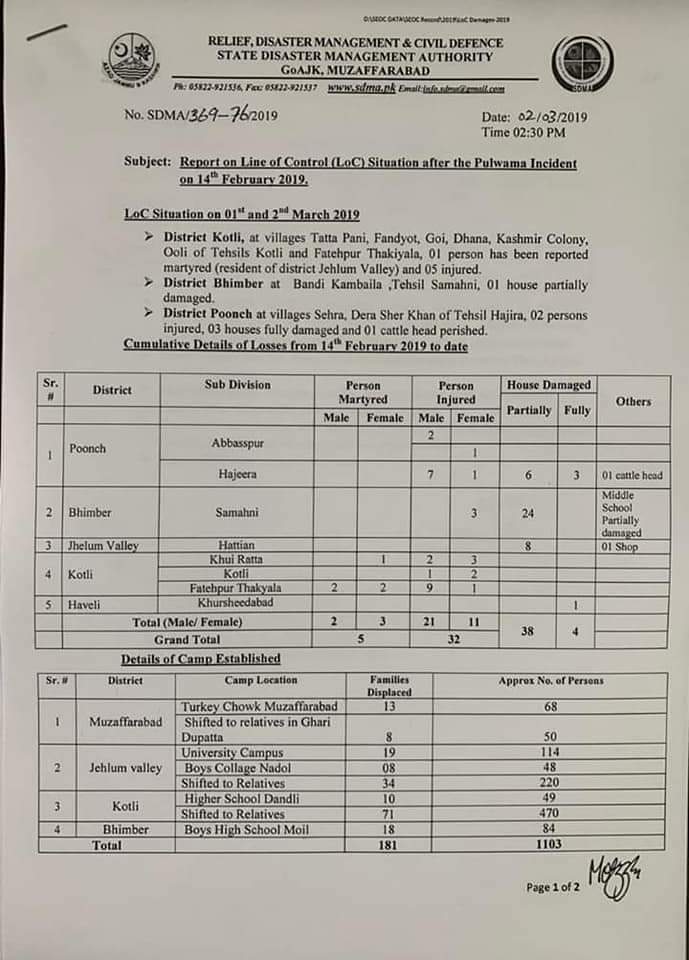
Page 1 of 2

Page 2 of 2
It was also on this day, that Mahmood Ahmed Musafir returned to AJK, after spending over a year on the road in public interest:

Sitting amongst his co-citzens in Dadyaal 

Friday, 1 March 2019

Daily Diary (DD) - Day 60 of 2019

1930hrs: Update from Tattapani (Kotli)
2 people are feared injured in continued cross-LOC firing

1947hrs:

We're still waiting for India and Pakistan to comprehensively defeat each other.....then we can get back to resuming some serious work for peace.

We have suffered further casualties in AJK, yesterday and possibly more today. I'm still waiting for confirmation of details.

Meanwhile, the aerial dog-fight in Jammu & Kashmir on the 27th of February (Day 58 of 2019) - barely 2 days ago - has received much attention. Senior Indian journalist Shekhar Gupta added further suspense yesterday evening. Details of exactly what happened that day are still far from clear, as all facts are not tallying:


According to Shekhar's information, the Indians are adamant that only 1 of their MiG-21s was shot down - not 2 - while they are also certain that a Pakistani F-16 was downed by an Indian MiG-21, which fell on the Pakistani controlled side they say. This doesn't tally with the MiG-21 that fell in Budgaam but it could help us in identifying the other pilot, which after all could've been the Pakistani F-16 pilot. Later, his name has even emerged as WC Shahzad.

However, Mr. Gupta was spot-on about military secrecy becoming a remnant of the past, in this digital age. However, we now have the increasing dilemma of countering fake or misleading news.

So we may need to further un-clutter the clutter.....

....
1949hrs: Update from Trarkhel
The sound of heavy shelling can be heard from the direction of Hajeera, for the past 3 hours.

2003hrs: Update from Kotli
Tattapani: 23 yeard old Asjad Akbar of Dhana has been injured from incessant cross-LOC firing/shelling.
- Cross-firing and mortar shelling in Kotli and Khuiratta too.

2007hrs: Update from Nikyaal
Near Kot - Old Eidgaah, a missile has hit a house where 3 people are feared dead and a further 2 injured. Heavy artillery is being used.
- 1 of them is thought to be 80 year old Nazir Ahmed of Dheri, Nikyaal.
- Indian mortar shells have reached Nikyaal bazaar in the past hour. One shell landed just near a petrol pump, windows in buildings have shattered too.
- The areas of Dabsi, Lanjot, Mohra, Dheri Dathote, Palaani, Peer Kalanjar and Tarkhundi are directly in the line of fire.
- It is reported that an Indian missile hit Paraawa Chowk in the centre of Nikyaal bazaar where 19 year old Sudheer Qureshi s/o Sai Qureshi of Hattian Bala was killed on the spot.

2239hrs: Update from Poonch  (on the Indian-controlled side)
- It has been reported that 3 civilians of the same family in Solatri village near Chakkan Da Bagh in Poonch district have been killed.
1) Rubina Kauser (Mother) - 32 years old
2) Faizan (Son) - 5 years old
3) Shabnam (Daughter) - 9 months old

Update from (throughout) AJK:
- Other reports indicate heavy cross-fire and shelling over the past hour near Tithrinote, Tattapani, Nikyaal, Kotli, Khuiratta, Hajeera, Neza Peer, Chowki and Smaahni.
- 7 people reported dead and over 25 seriously injured.

2245hrs: Update from Poonch and Kotli Sectors (on this side)
- 4 killed and 27 injured in various locations in Poonch, Battal, Tattapani, Thithrinote, Darra Sher Khan, Nikyaal and Abbaspur.
- Heavy shelling continues at Digwar (in Abbaspur this side) and Krishna Ghatti (in Poonch on that side)

2315hrs: Update from Haveli
Heavy cross-fire reported from here too.

Thursday, 28 February 2019

Daily Diary (DD) - Day 59 of 2019

1143hrs: From Poonch Sector
Madaarpur and Battal on the LOC witnessed Indian and Pakistani cross-firing throughout the night. This continued with mortar shelling in the morning. No report of any casualties as yet. 

1147hrs:

The morning after an exhausting day yesterday. It could have been even more exhausting if I'd been involved in a current affairs debate on international media, as it looked likely at one stage.

Here's a late tweet that I wanted to embed in this diary yesterday:


Musafir setting - what remained of his camp - on fire yesterday:


This is an overview of his year long fight in AJK and Pakistan:


Mahmood Ahmed Musafir has never been a character who would allow anybody else to upstage him. Not even an India vs. Pakistan war in Jammu & Kashmir. 290 days of camping outside Islamabad Press Club in Pakistan drew to a close yesterday with that almost ceremonial burning of his camp. Yesterday also marked the end of one year of being on the road, fighting for public rights.

He needs a little rest now I would suggest, before beginning the next round of his struggle.

1329hrs: in Dadyaal
Pakistani aircraft continue hovering in the skies above......a lot of work is also being done on the propaganda front. A couple of hours ago I could hear people chanting slogans of "Pak Fauj - Zindabad" (Long live - the Pakistani army).

Here's a tune which in words exemplifies how Pakistan is celebrated using iconic Islamic metaphors, to create that important parallel. This lobby is a genuine constituency in AJK and amounts to roughly 25% of society, though it can slightly increase during these 'patriotic' times:


Art is a powerful tool to build or sustain a narrative: It works both ways though and about 75% of our society doesn't properly realise that.

1823hrs:

Looking back on yesterday's event in the skies and on the ground near the LOC in AJK:

Interpreting what happens in real-time during a conflict - especially that between India and Pakistan in J & K - is not easy.

It now appears that the 2 Indian military aircrafts (MiG-21 Bison) were tailing 3 Pakistani military aircrafts (F-16), who according to Pakistani reports had dropped bombs in non-populated areas of Indian-controlled J & K. Apparently, this was just to give a message to the Indians that they could also do what the Indians did in Balakot. That in Pakistani terms was that the Indians had also dropped bombs on empty land.

In any case, an aerial dog-fight ensued and the 3 Pakistani F-16's were joined by another, or even 2 if reports by the Indians that they had shot down an F-16 were to be considered accurate, as they entered Pakistani-controlled airspace. The 2 Indian MiG-21's were shot at, one retreated as described yesterday when hit and ended up falling dozens of kilometres away in Indian-controlled airspace above Budgaam. The pilot or (2 pilots as some reports suggest) were already dead when the debris of the plane hit the ground.

The second Indian MiG-21 with the now famous wing commander Abhinandan ejected from the plane in time and landed by parachute in a local stream in Oraah, Poona (tehsil Smaahni). Having a close look at that initial video, where it appeared locals converged to lynch the pilot: those supposed locals seemed more like plain-clothed military personnel or intelligence operatives. Indeed, the guy punching him was also seen later (with ammo) escorting him alongside the Pakistani army in later photos.

Here's an example:

The gentleman on our right is the one who was punching him

I would like to identify him and am trying to do so. That will be difficult if he is military but we can still try.

There was a flurry of social media activity - from the Pakistani perspective - that local Kashmiris (or citizens of AJK) would have lynched him to death if the Pakistani army did not 'mercifully' intervene. I even apologised for my people, if indeed they were responsible for trying to lynch him.

Finally, the other Indian pilot who we were 'reliably' informed had been taken to CMH Rawalpindi, doesn't exist anymore as far as both Indian and Pakistani media are concerned.

We could still have further surprises ahead.     

Wednesday, 27 February 2019

Daily Diary (DD) - Day 58 of 2019

0815hrs:

The past 24hrs indicate a move towards a war footing in many parts of the region. Both armies have been busy killing each other, while our civilians get killed or injured for free and without agency.

Some food for thought in this picture:


0845hrs:

Here's the Urdu version of our pitch for peace during war:


Update 0940hrs: From Dadyaal
A lot of aerial commotion with Pakistani military aircraft disturbing the otherwise peaceful airspace here. This war is certainly escalating for a number of reasons......

Update 1501hrs: From Khuiratta and Charoi

It almost feels as if we have suddenly moved near to a busy international airport, except that the only aircraft on the horizon are military. Cross-fire and shelling continues unabated in various sectors along the LOC in AJK and along the working boundary (province of Jammu adjacent to Pakistani Punjab).

An Indian fighter plane was downed this morning at around 1000hrs in AJK. It had been hit by Pakistani fire and its pilots ejected via parachutes, according to eye-witnesses. Another Indian fighter plane was flying in tandem with this but when it got hit it retreated back across the LOC and we understand that it finally fell in district Budgaam of the Kashmir Valley. Meanwhile, this other Indian military plane had been surrounded by 4 Pakistani military aircraft leading up to this aerial confrontation.

The precise location of the pilot's fall was Oraah near the town of Poona in tehsil (subdivision) Smaahni. Both pilots have been detained and one is reported to be seriously injured. He has been shifted to CMH (Civil & Military Hospital Rawalpindi). Locals have been informed by Pakistani military personnel that they (the Indian aircraft) wanted to bomb the Mangla Power House. From personal experience, it is difficult to rely on the words of any military during a war.

After 1100hrs, there has been total silence in Khuiratta sector. Cross-firing and shelling has also halted, within an hour of this incident.

A View of Smaahni Valley where the Indian Plane was Downed

Detained Indian Pilot being Transported 

Sky News in the UK also covers this story somewhat:
Pakistan shoots down two Indian warplanes and captures pilots

I know the following video is going to be contentious at some level but it is being shown for it's news value and not to take any sides in this un-necessary conflict. We are neutral to the core and pro life to the extreme:


Update 1415hrs: From Poonch Sector (on the Indian-controlled side)
- In the Chajjala area of Mendhar, one woman died after sustaining critical injuries from a mortar shell, officials said.
Source: Jammu Links News

Update 1532hrs: From Neelam Valley
Mobile and internet services have been blocked throughout the district

1849hrs: From Tattapani (Kotli) and Poonch
Serra and Darra Sher Khan are under fire after a break of 8hrs

Update 2005hrs: In Dadyaal

Indian airforce Wing Commander Abhinandan Varthaman. I sincerely am sorry - the fact that he's South Indian amplifies my emotion - because they are generally very amicable people and don't carry the burden of identity, like the North Indians and Pakistanis do. I repeat that I am ashamed of the probability that my fellow aspiring citizens of AJK appeared to lynch him.

In this age of social media, Delhi, Islamabad and Poona (in tehsil Smaahni) are literally nano seconds away from each other. Transparency and responsibility for conduct can take humanity very far, I'm sure.


Tuesday, 26 February 2019

Daily Diary (DD) - Day 57 of 2019

1525hrs:

I woke up today to learn that there had been some war activity over the territory of AJK. In fact, Indian fighter jets had flown over AJK and bombed what they described as, "JeM militant camps" where they claimed - according to Indian media reports - to have killed over 300 militants, in the Pakistani territory of Balakot (in KPK) at about 0300hrs, barely a few kilometres from AJK's border with Pakistan.

Now, about 12 hours later the propaganda war between the 2 countries is in full swing, obfuscation and delerium in equal measure. We, the inhabitants of J & K don't exist, irrespective of whether there is peace or war on the horizon.


Update 1908hrs: From Kotli
DHQ Hospital takes emergency measures to take in injured from heavy shelling in Charoi, Khuiratta and Nikyaal tehsils (sub-divisions)

Update 1924hrs: From Smaahni
Receiving reports of heavy cross-shelling and firing in Bhimber Sector too

Well, at least the Valley of Kashmir is quite today. Is there a correlation?

Update 1946hrs: From Khuiratta
Pakistani firing...more than the Indians...from Darghuti....heavy fire....since 1500hrs......4 injured civilians in Khanpur ambulanced to Kotli.....Karghut - 8 to 10 ambulances dispatched to PK army....

.....

Update 1931hrs:

Here's a perspective courtesy of Twitter:


.....

Update 2010hrs:
1 of the 4 injured succumbed to her injuries

Dead:
Shanaz Siddique w/o Raja Muhammad Siddique - female

Injured:
Adnan s/o Muhammad Aslam - male
? Kausar d/o Muhammad Karamat - female
Sumehra d/o Muhammad Aslam - female

Update 2013hrs: From Nikyaal
Mohra Dhruti....Malik Umar Hayat House...
- 3 of this already deceased gentleman's family members have now been killed in this fresh Indo-Pak confrontation along the LOC..
- A further 3 members of the late Umar Hayat have been injured.

Dead:
Motiyan Begum w/o Umar Hayat - 40 years - female
Zarina d/o Umar Hayat - 15 years - female
Gulfraz s/o Umar Hayat - 9 years - male

Injured:
Umar Farooq s/o Umar Hayat - 17 years - male
Sarfaraz s/o Umar Hayat - 12 years - male
Sagheer s/o Umar Hayat - 10 years - male

Update 2117hrs: From Hattian - Jhelum Valley (Muzaffarabad Division)
All hospitals in the district have been put on high alert.

Also plenty of aerial movement reported from all 3 divisions of AJK

Update 2210hrs:

I sent out the following audio message in English:


Update 2316hrs: From Kotli
Reports of activity in Tattapani and further north along the Poonch Sector

Update 2331hrs: Working Boundary (The area of Jammu & Kashmir controlled by India opposite Pakistani Punjab - Sialkot, Narowal, Shakergarh etc.)
Reports of tank build-up here

Here's some footage on the ground in Tattapani, Nikyaal and Khuiratta:


....
  
Coming back to the ground where this territorial conflict really matters, here's a scene from Gilgit Baltistan:


.......

In an effort to remain sober about this needless and expensive conflict thrust upon us, I became engaged with the following question on the 19th of February:


So here's my engagement:

I'm pretty impressed with the structure of this website and the promptness equalled by thoroughness of the administrators. Only I wish I could embed the conversation here.

Initially, on February the 19th I submitted all 3 primary reasons for why Kashmir should be independent.

Note:
I'm using the term 'Kashmir' in the most easily understood modern political sense. That is Kashmir as short-hand for the whole erstwhile princely State of Jammu & Kashmir, whose measurement equals roughly 86,000 square miles. Roughly because varying figures are quoted by writers across the geo-political spectrum. This territory can most easily be divided into seven (7) distinct regions, for the dual purpose of understanding its possibly divergent/convergent internal narratives and 72 year administrative history.

1) AJK = 6% of land and 20% population of J & K under Pakistani control
2) Aksai Chin = 14% of land and 0% population under Chinese control
3) Gilgit Baltistan = 29% of land and 9% population under Pakistani control
4) Jammu = 12% of land and 30% population under Indian control
5) Kashmir (Valley) = 8% of land and 39% population under Indian control
6) Ladakh = 28% of land and 2% population under Indian control
7) Trans-Karakoram Tract = 3% of land and 0% population under Chinese control

Further notes:
- One had to extrapolate percentages (using round figures) from a lot of different sources, none of which tally. Therefore Ladakh's land may actually be more of a percentage than quoted and the Kashmir Valley less than quoted.
- Siachen Glacier is a part of Baltistan but is directly controlled by India and Pakistan respectively without any internal State-level administrative link.

Now, let's return to the question: Should Kashmir Be An Independent State?

My 3 primary reasons have each been submitted separately after discussion with the admin at Kialo.com .

1) A neutral confederation of States replacing the old princely State of Jammu & Kashmir, will bring stability and advance economic progress in Asia, much like Switzerland did in Europe.

2) An independent Kashmir will greatly enhance water management technology in the region because its survival will depend on efficient supply of that water to the thirsty plains of India and Pakistan thus averting future wars over water.

3) Geographically, this region is at the intersection of diverse civilisations, harmony here could avert ideological wars elsewhere.
Human rights and religion in Kashmir

These were the threads leading up to the engagement:

Kialo 20/02/19:
Hi @AJK_Public_Agency, thanks for some amazing ideas! It occurs to me that there are a few separate ideas here, each of which might be worth developing as a separate claim? You could maybe create a separate claim to talk about efficient water use, and another to talk about promoting ideological harmony? The water claim might fit well into existing threads about Kashmir's strategic resources and rivers (here: Kashmir is extremely important to Pakistan as the source of its major rivers).

I'm afraid I don't quite understand the first idea you introduce though - why exactly would an independent Kashmir help promote stability and economic progress? And why is it like Switzerland?

Thanks again for contributing!

My response to Kialo 25/02/19:
As for your question(s): "why exactly would an independent Kashmir help promote stability and
economic progress? And why is it like Switzerland?" The answer to both parts of the question are intertwined.

This is Asia's century as forecasts go but is riddled with conflict in key areas such as Kashmir, which links to many of the old silk routes. Take a look at an economic map of Asia a thousand years ago. For India & Pakistan as well as China and Russia many criss-crossing routes for un-explored or under-utilised markets in the modern age, pass through this territory.

Our neutrality could change the political economy of the region (from conflict based on proprietary claims on neighbouring territories, where religious identity is used as a majoritarian weapon to compete on 'securitisation': to a people's narrative driven economy where citizens, as default arbiters of their inherited territory - are desperate to make their lives useful and ther democratic opinion valuable - opening routes would be fundamental to this turn-around) and there is some correlation between Swiss neutrality and European progress.

Furthermore; geography, topography, ethnic diversity, flows of major rivers into other neighbouring territories are all 'closer to nature' similarities with Switzerland while direct democracy, confederacy and neutrality are all favourable precedents for Kashmir (or the whole erstwhile princely State) to adopt.

We can take this discussion deep into history and use various analogies when comparing it to Switzerland, which announced neutrality in 1515. This stance gradually help fend off competing regional empires. Despite Switzerland's ethnic diversity, languages and proximity to larger powers it held together through sheer will of the people there, who were adamant on a distinct identity. All these traits are visible - if seemingly un-refined - here.

I am not the only one making this proposition or coming to such a suggestion for conflict resolution. Despite arriving at my conclusions through independent research on the ground here since 2005, I was pleasantly surprised to learn that an American journalist who covered this region extensively in the volatile 1990s, had made a similar assessment. Here's a link to her presentation at: The Hague in 1999

End of response......

Kialo:
@AJK_Public_Agency That's fascinating! Thanks so much.

Then, further elaboration was needed on primary reason number 3, namely:
 3) Geographically, this region is at the intersection of diverse civilisations, harmony here could avert ideological wars elsewhere.
Human rights and religion in Kashmir

Kialo 28/02/19 (Updated):
@AJK_Public_Agency This is an interesting idea - but I'm not entirely sure what you mean by "intersection of diverse civilizations" are you meaning in a religious sense?  As India and Pakistan were only partitioned in 1947 it seems unclear to me what you mean by this?

My response to Kialo 01/03/19 (Updated):
Well, if we were to account for just South Asia (including India & Pakistan) then yes the religious divide does appear prominent vis a vis Hindu and Muslim. However, a 360 degree view of the geography around Jammu & Kashmir would indicate historic exposure to diverse cultures/religions/languages/races etc. such as Central Asia (including Afghanistan, Iran and Turkey) as well as China.

Let me illustrate further:

Thus:  There are many religions, in or surrounding the State of Jammu & Kashmir -
Buddhist, Confucianist, Hindu, Muslim, Sikh, Taoist with many varieties of Muslim including further biblical connections with Christian and Jewish links...the 'Throne of Soloman' in Srinagar for example.

Many races:
Caucasoid. Mongoloid and Australoid
- If we adopt mid 20th century racial classification by American anthropologist Carleton S. Coon, who divided humanity broadly into five races. This would mean we host 3 of 5 globally.

Many ethnicities:
111 have been studied in just the Indian-controlled part of Jammu & Kashmir by the anthropolical survey of India.

Many languages:
Pahari (with variants such as Gojri, Dogri and Hindko), Kashmiri, Punjabi, Balti, Sheena, Ladhaki, Burushaski, Wakhi, Khowar and Bhaderwahi.
Officially English, Hindi and Urdu with heavy remnants of Persian still in use.

Many Cultures:
Influences within the wider geographic region as well as beyond are clearly visible in the major expressions of dress, food and living environment. It could be argued that the Kashmir Valley itself is most syncretic because it happens to be virtually in the geographic centre of this wider network of old silk routes or the wider State of Jammu & Kashmir, in its modern context. 

Geo-politics:
This region has also been at the cross-roads of many colonial/expansionist influences/tendencies throughout history.

End of response....

Kialo 03/03/19 (Updated):
@AJK_Public_Agency That is really interesting!  I didn't know many of those things. I'm just trying to think how we could incorporate some of that into the claim. I think we would also need to explain how this would avert ideological wars elsewhere - as i'm not sure how these diverse language and cultural backgrounds manifest themselves other than the conflict between India, Pakistan, China etc over Kashmir?

My response:
Well, this is where all 3 primary pros entered for this argument rely on each other to make an independent Kashmir practical.

Yes, that can be pondered over as to what can be added further to the argument.

Well, as the region is on the periphery of these contesting/colluding powers it cannot be central or even integral to how those countries function. All 3 are using expansionist - as opposed to genuine democratic - tools to expand the 'idea' of their respective national identities. This disenfranchisement means the onus is on us to prove our neutral geo-political tendencies (pro 1), water management technological capability (pro 2) and the will to distinguish our national identity in a diverse polity with divergent temptations (pro 3). The latter argument gives us a precedent in Switzerland (Please refer to my explanation for pro 1). We can use our history to reference quasi democratic traditions in autocracy, through the lineage of Kings ref. Prem Nath Bazaz (1954) The History of Struggle for Freedom in Kashmir: Cultural and Political, from the Earliest Times to the Present Day. Kashmir Publishing Company. We also have a rich heritage of knowledge at Sharda, which some even describe as the oldest university in the world.

In short, our needs can take some inspiration from our heritage and parallel(s) to Switzerland to refrain from colluding with our neighbours, who are using ideology and or religious identity to attach us as a periphery to their respective centres. A neutral Kashmir would help our neighbours divert their energies elsewhere. Hopefully, away from conflict. This could have a positive spin-off elsewhere too.

End of response...

Kialo 04/03/19 (Updated):
@AJK_Public_Agency It seems to me that the key idea here is "A neutral Kashmir would help our neighbours divert their energies elsewhere. Hopefully, away from conflict. This could have a positive spin-off elsewhere too". Do you have some sources that might be able to back up this idea?

My response 05/03/19 (Updated):
Well, sources related to neutrality and Switzerland provide precedent, as already cited. Admittedly, it is difficult to be counter-factual here.

If such a diverse a region as J & K with potentially deep ethnic faultlines succeeds as a distinct polity, it would not only compel India and Pakistan to concentrate on alternative matters more central to their existence (education, health and employment of their deprived masses for example) but other regions of the world which usually get trapped in conflict based on religious, sectarian or other ethnic considerations could also possibly adjust their priorities likewise.

In Kashmir, we have enough of a diverse heritage to build on, which cannot happen when 3 neighbours are competing for our land, minus the people.

In terms of re-phrasing the argument, I would suggest the following although I appreciate that it may need further refining or substantiation:

Geographically, this region is at the intersection of diverse civilisations, utilising the rich and  diverse (spiritual and knowledge-based) heritage of this region could help convert the ideological expansionism of our neighbours into a more effective pro-life approach towards their own citizens. Becoming a venue for refined civil interaction that replaces military confrontation would also be an inspiration for other regions mired in identity-based conflict.

End of response....

Kialo 06/03/19 (Updated):
@AJK_Public_Agency I think that we are getting closer - can i suggest wording "Geographically, this region is at the intersection of diverse civilsations, utilising the diverse heritage of this region could help divert the ideological expansionism of its neighbours."  Then we could have separate claims beneath that to prove that it is a diverse (spiritual and knowledge based  region and also some claims about why this would divert Indian and Pakistani attentions to their own citizens?

I think the point about "becoming a venue for refined civil interaction..." is a completely separate point.  The only issue I have is that i'm not sure what the arguments for saying that India and Pakistan would become more interested in their approach to their own citizens would be.  I know you have the example of Switzerland but I think thats quite different because Switzerland had a long history of neutrality and I think is in a quite distinct position from Kashmir in that it has never been a disputed territory.  So i think in order to argue this we would need to provide more support than just "see it works in Switzerland".

My response 07/03/19 (Updated):
Yes, I appreciate you putting so much time and thought to this. I am thoroughly enjoying the exchange too. I think the way you have phrased it seems fine and I take along your point of adding the various arguments beneath it. As for India and Pakistan then becoming more interested in their approach to their own citizens, I think that would be inevitable given the huge military resources in use and ideological warfare both countries have been engaged in to gain the upper-hand against each other.

Both have also been very poor in water management despite sharing the water sources emanating from Kashmir. A lot of features of governance that 'normal' countries proceed with have been ignored by both countries over the past 72 years. The constant threat of war and publicity regarding it does sap one's energies. Indeed, both countries have much to benefit from trading with each other, which has been heavily restricted since 1947.

As for Switzerland, there is definitely a huge time lag and difference in political evolution between it and Kashmir. Switzerland was a disputed territory and that's why it declared neutrality in 1515. However, I do agree that any similarities between the 2 need to be qualified. I think my point is rather more eloquently described by Kathy Arlyn Sokol in the reference I gave for pro 1. Here's the link again.

.....

Monday, 25 February 2019

Daily Diary (DD) - Day 56 of 2019

0123hrs:

I have to begin today from where I ended yesterday. That is remaining in the exact same place either side of midnight. 

I can kick off with this retweet from yours truly:


.....

Then it's time to translate the following document:

Mahmood Ahmed Musafir's Farewell Flyer 2.0

The earlier farewell bid (1.0) was on the 24th of October 2018 and had to be aborted for logistical reasons.

Here's the translation:

--------------------------------------------------------------------------------------------------------------------------

I'm (described as) an apostate and traitor if I speak the truth.
Mad is my humble being they say, if I were to lie then my humble being would be a hypocrite.

That's why this humble being is migrating from here.
This humble being will live his life wherever he will find (a civilised) abode.

--------------------------------------------------------------------------------------------------------------------------

The public enemy policies of the authorities in Azad Kashmir and Pakistan have forced me to take this step to migrate from Azad Kashmir and Pakistan towards an (as yet) unknown destination, where I can hide my head.

I will break my hunger strike since (which began on) the 14th of May 2018 and eat food (Musafir has survived on liquids during this period) in such an (conducive) environment where I will be able (given the opportunity) to produce electricity without any of the following (recognised) methods:

Water, diesel, petrol, gas, coal, paraffin oil, atomic power, solar power, furnace oil, dry battery, seawaves, garbage and even without wind, if necessary.

--------------------------------------------------------------------------------------------------------------------------

The thought and concern of:

Their Excellencies; Allaama (Professor) Iqbal, Faiz Ahmed Faiz, Ahmed Faraz, Habeeb Jaalib and Ubaid Ullah Sindhi.

(An attempt was made to convey to):

Your Excellencies; the president of Pakistan, the prime minister of Pakistan, the 72 year old advocate of Kashmiris - the Islamic Republic of Pakistan and the so-called government of Azad (free) Kashmir.

For 26 years I have searched for Islamic fairness & justice, human rights organisations and (legal) courts.

--------------------------------------------------------------------------------------------------------------------------

A bright and prosperous Azad Kashmir - A bright and prosperous Pakistan
As I've committed the crime of desiring prosperity of mankind (I bid)
Farewell Farewell Azad Kashmir - Pakistan Farewell

--------------------------------------------------------------------------------------------------------------------------

Whilst there are thousands of PHD graduates here and hundreds of thousands of double and triple Masters engineering graduates; yet this country is still bankrupt, mired in a darkness of owing debts upon debts. Why?

Khyber Pakhtunkhwa, Sindh, Punjab, Baluchistan, Gilgit, Kashmir and in particular Tharpaakar (Sindh) are where the public are deprived of a morsel of food, justice, education, healthcare, clothes and clean drinking water. Why?

A few families have illuminated abodes while the rest make do in darkness. Why?

--------------------------------------------------------------------------------------------------------------------------

Load-shedding (of power supply) and expensive electricity.

Expensive education with a dishevelled curriculum and educational institutions without roofs, protective four walls or toilets.

Unclean common drinking water sources that lead to hepatitis and HIV aids.

Cruel termite-infested banking system.

There is a different set of laws for the rich and poor (in practice).

Zakat (compulsory alms-giving) and its institutional structure 'Bait ul Maal' (House of Wealth) including schemes such as Benazir Income Support Programme and Health Card, are all a cruel joke at the expense of the poor.

Young children and women are victims of violent sexual assault.

Freedom of expression is prohibited. 

The United Nations Charter and the constitution of Pakistan have been (practically) abandoned.

Farmers, physical labour and creative writers are economically strangulated.

The children of those in power are facilitated with permanent occupations (job positions) while the children of the poor are subject to ad-hoc-ism and employment on contract policies.

98% of the bureaucracy is unbridled, (are compulsive) liars, hypocrites, tricksters and enemies of Socrates (5th century BC Greek philosopher).

I repeatedly reject this so-called democracy.

--------------------------------------------------------------------------------------------------------------------------

If you have power in your (educational) degrees then produce electricty at Siachin (Glacier).

If you can't do that, then burn your degrees and then..............(Musafir leaves the rest to the reader's imagination)

--------------------------------------------------------------------------------------------------------------------------

Mahmood Ahmed Musafir

Contact Numbers:
03415935557
03065838206

--------------------------------------------------------------------------------------------------------------------------

End of flyer translation....


Note: anything in brackets in the translation above is my emphasis, to make the text easier to understand.

....

Sunday, 24 February 2019

Daily Diary (DD) - Day 55 of 2019

2331hrs:

Meaningfully organising what one has done during the day, is also a time-consuming chore at times. Yet it's a necessity in public interest. not least for posterity. 

With less than half an hour to Day 56 of 2019, I still have at least 4 tasks to complete before I sleep. Yet none of them are related to my main priority: Citizen Public Opinion Survey - AJK : Report 2.0 

The latin phrase carpe diem (make the most of today, tomorrow may not come) comes to mind as does an article that I was reading earlier on medium.com.

Meanwhile, where we've given so much time to the K in J & K, it would be appropriate to feature aspects of the J (for Jammu) narrative, even if it's just an atempt to veer towards balancing the stakes.

Here's a news clip from yesterday entitled, "Jammu Muslims condemn Pulwama attack, say non-locals were involved in violent Jammu protests":


Today, the local administration in Jammu has also spelt out its intent towards miscreants:

It has come to notice that some rumour mongers are spreading rumours of Bandh Call and Curfew in Jammu. People are requested not to pay any heed to rumours. Situation in Jammu is peaceful and there is no such Bandh Call or Curfew planned by administration. To ascertain any unsure information on social media or otherwise, People are requested to confirm same either from DC Office Jammu controls Room or Police Control Room. Rumour mongers will not be spared.

By Order:
District Development Commissioner Jammu, Ramesh Kumar

News source: Jammu Links News (via Whatsapp)

This was my immediate reaction:

There is nothing more valuable in the pursuit of State reformation of J & K, than a stable Jammu.

Saturday, 23 February 2019

Daily Diary (DD) - Day 54 of 2019

2047hrs:

So the local administrations on both sides of the Line of Control (or Line of Military Occupation - LOMO - to be more precise) have been instructed to move civilians away from the dreaded line, over the past couple of days. We also understand that many people in cities like Srinagar are hoarding grain and other essentials, in anticipation of?

Living on the 'cold' border here in Dadyaal, adjacent to the Potohar region of Pakistan (we describe the LOC as the hot border in this context), it is difficult to estimate the level of tension our citizens have to encounter, whether they are living near the LOC or in volatile urban centres like Srinagar and of late, Jammu.

The responsibility to seek respite from this tragedy is more on our relatively comfortable shoulders than it is theirs. 

It should also be noted that whenever relations between India and Pakistan take a nosedive, its effects are usually played out here in Jammu & Kashmir, while India and Pakistan proper (as in their legal territories), enjoy immunity. In other words, they fight in our territory and not their own.  

This is a sample of what it feels like to be a citizen at the heart of this imposed conflict:


In sharp contrast, here's a very sane letter written by former Indian Navy Chief Admiral Laxminarayan Ramdas to President Ram Nath Kovind, in the aftermath of the suicide attack in Pulwama.

He re-iterates the following 2 points - hitherto echoed in abundance elsewhere by others - before appealing for calm and clear thinking in pursuit of a solution.

1) The solution to the Kashmir problem is political, not military.

2) No amount of force as part of the avowedly ‘muscular’ Kashmir policy can quell the anger that Kashmiri youth are experiencing.

.....

To capture the zeitgeist (spirit of the age) in the context of Jammu & Kashmir, the discussion below had 3 very qualified proponents. Incidentally perhaps, they are all female and this chimes with my accumulated opinion that female intellect will be far more effective in delivering a solution to this un-necessarily protracted conflict:


Ayesha Jalal in particular is almost astounding in her analysis.

Friday, 22 February 2019

Daily Diary (DD) - Day 53 of 2019

1455hrs:

Once in a while, I get to read a riveting article in a Pakistani newspaper that takes the 'bull by the horns' in its analysis of the malaise of Pakistani polity. Not least because it directly affects us in AJK and GB.

Killing history  in today's Dawn is one such article.

Meanwhile, I found the following interview on JKTV even more riveting. Dibyesh Anand is an expert on modern colonialism and thus his views on Jammu & Kashmir need to be taken very seriously. Our traditional nationalists have much to learn from his educated wisdom:


...

Thursday, 21 February 2019

Daily Diary (DD) - Day 52 of 2019

1746hrs:

A dark overcast day ensured that I wouldn't leave home today.

I sent out the following question in some Whatsapp groups today:

Sponsoring War vs Sponsoring Peace
How has the public of AJK historically performed in this regard?

About 6 hours later, I'm yet to receive a meaningful response. Thus, I'll write a little commentary on it myself:

In the greater scheme of things since 1947, our public have sponsored war far more than they have sponsored peace.

The late 1980's and 1990's are a particular case in point. Our public in AJK as well as the diaspora - particularly in the UK where taxi drivers, restaurant/hotel owners, shopkeepers and the like regularly collected funds and sent them to AJK - to be passed onto the 'mujahideen' who were regularly crossing over to the Indian-controlled side of Jammu & Kashmir, to physically oust the Indian army. Relatively affluent locals here (in AJK) didn't shy from contributing regularly either.

Three major factors for this energetic fund-raising emerged:

1) The Pakistani State was backing this funding drive, thus logistics, publicity and the institutional structure in place here facilitated this process.

2) Our people have always tended to be attracted to the lure of major achievements in a short timeframe. For example, it was repeatedly propagandised on Pakistani State media that Indian military withdrawal was imminent.

3) It was easy to convince our gullible people using the emotion of religious identity, to back a Muslim effort to rid a coveted territory of Hindu rule. In a sense, it was 1947 re-enacted. Indeed, the Kashmiri Pandit community of the Valley suffered in a manner, that was worse than anything they had to endure in 1947. This time there was an exodus. Some blame can undoubtedly be attributed to Governor Jagmohan but if some of the local Muslims of the Kashmir Valley hadn't targetted the Kashmiri Pandits and if some Muslims hadn't made suggestive announcements on loudspeakers in various masaajid in the Valley, an exodus on the scale that occurred may have been averted.

The absence of these three factors in the pursuit of genuine peace means that any dedicated public rights activist has to bear a huge personal burden, just to survive - let alone succeed - in such an environment.

On my visit to the Valley of Kashmir in the summer of 2009, my host - the late Shujaat Bukhari - raised a valid question as to how I will fund the development of civil society in AJK. My response was that the very people who had so generously funded war and lived through the failure, should be able to understand the importance of funding peace.

However, my response didn't fully take into account the above three factors cited. As sponsoring peace requires the following opposing attributes to succeed:

1) We cannot canvass for the backing of other nation states (and certainly not Pakistan which has its own axe to grind) or even foreign NGOs, as some of our citizens are keen to do. Logistics, publicity, funding and all other aspects of building an indigenous political process have to be created by our very own citizens. Indeed, this is an explanation of self-determination, in our particular context.

2) There are no short cuts to conflict resolution. Our public has been repeatedly stung by short term tactics (of war and subterfuge) which ultimately makes our struggle more complex, requiring even greater amounts of peaceful lobbying to unlearn all the propaganda driven into us. Obtaining funding for something that is not immediately redeemable in an environment with such a history, is very hard work.

3) Sponsoring peace entails meticulous and painstaking research to cut out ambiguity of public opinion, counter false/self-serving propaganda, develop a modern structure of governance and  perhaps most important of all; repairing relations with our citizens who do not adhere to the majority religion in the region. In other words, taking a humane approach rather than trying to extract preferential treatment under majoritarian principles.

In summary, this is a battle to foreground the people's narrative against a securitisation narrative conveniently employed by our occupiers.

End of commentary...

...

Meanwhile, I know our people (citizens of undivided J & K) can become buoyant whenever some significant Indian or Pakistani talks 'our' language but we almost always forget that all the 'footwork' required to create a solution remains our responsibility:


.... 

Daily Diary (DD) - Day 270 of 2026

1124hrs: On this 115th day, I think we may just have cracked the internet code, at least for the time being in any case.  ....