Sufi Muhammad Zaman: An embodiment of self-awareness
At a particular juncture wherein so-called Azad Kashmir receives as few as six hours of electricity in every twenty-four, despite generating more than six times it's need, the citizen of Kashmir would do well to remember the life and times of Sufi Muhammad Zaman - activist extraordinaire and selfless soul – born to a humble family (whose ancestry originated from the Valley of Kashmir) in Bharmat, old Mirpur in the year 1924.
Sufi Sahaab spent his life working to re-instate the deprived freedom of his motherland. He always undertook the torment and torture of false imprisonment with a smiling face and well-chosen words for his interrogators. His waking moments were occupied with addressing the injustices endured by the working classes and downtrodden. His shop 'Awami Boot House' doubled as a nurturing and mentoring venue, it was also referred to as Mirpur's equivalent of Speaker's Corner (Hyde Park - London), always open to the public for refreshment and discussion. His character embodied freedom and love, his criterion was always humanity. Sufi Zaman dreaded fame and fortune, simplicity and agriculture were his traits. His death on the 25th of May 1981 came as a shock and irretrievable loss to the hundreds of thousands that knew him.
This writer hadn't heard of him until he came across an urdu book "Mard-e-Khud Aagah" (A self-aware man) collated and compiled by Sufi Sahaab's younger brother Abdul Jabbar Butt, a well-known activist and intellectual in his own right. In his preface, he stresses on the need for today's youth to understand the emotion and character of his brother Sufi Zaman, which he attributes to the sterling method of upbringing that his parents had delivered to each and every sibling in the family. The term 'sufi' was attributed to him for his regularity in islamic ritual. He differed from many others by his adherence to humanistic ideals and refrained from judging others in terms of their particular personal beliefs or which sect they belonged to.
His political career had already taken root before 1947 when as a party worker of the Muslim Conference, Sufi Zaman spent time in jail for his outbursts against the Maharajah's autocratic rule and associated injustices. With the emergence of a ceasefire line dividing Kashmir, Sufi Sahaab considered it a line that kept two sets of Kashmiris in opposing jails. He also realised the futility of remaining with the Muslim Conference. It was a political organisation with three conflicting factions. One was led by Sardar Ibrahim of Poonch, another by Choudary Ghulam Abbass of Jammu and the third was led by Mirwaiz Yusuf Shah of the Valley. The aforementioned were largely interested in jockeying for favour with Pakistan and securing an income, rather than addressing public need. The party was also littered with all those who had previously benefitted from the Dogra regime. Each and every occupation of public significance was alloted to party members. Above all, the Muslim Conference's sponsor: Pakistan, wasn't sincere with the Kashmiri cause.
Sufi Zaman's first post-47 initiative was to join and build the "Awami Muslim Conference" in 1951 (or 1952)*, after some initial hesitation on account of his bitter experience with the Muslim Conference. A year later, the title was changed to "Awami Conference" as sectarian division began to emerge in the party. It was an era when opposing the Muslim Conference was virtually suicidal. Anyone who opposed the only 'legitimate' form of political activity would have their faces blackened and paraded in public. The police, administration and judiciary all operated 'hand-in-glove' to maintain this status quo.
The Awami Conference had a bold progressive manifesto despite it's incipiency and the hostile environment it operated in. No less than total freedom and independence for the erstwhile Dogra State of Jammu and kashmir, avec unity and integrity, a non-discriminatory democratic government free of any bias, an end to the interference of the Ministry of Kashmir Affairs, revocation of the Karachi Agreement and full adult franchise to determine representation of the Azad Kashmir public, including Gilgit Baltistan and refugees of the State living in Pakistan. It also wanted a legislative assembly instated forthwith and recognition as an independent country.
By 1962, Pakistan had well and truly placed the 'Kashmir Issue' in a faint background by suppressing the will of the people in Pakistani-administered Kashmir. This enabled them to assert the construction of Mangla Dam. Many villages, including Bharmat (Sufi Sahaab's birthplace) were to be submerged under water and like thousands of others, his family was also forcibly evicted. This juncture in Sufi Sahaab's life possibly solidified his resolve. He considered that our neighbouring country Pakistan had no right to make structural changes to a territory it had no sovereign right over. He felt this trampled the rights of the citizen of the State. What made matters worse was that Pakistan was settling outsiders (Pakistanis) into the State to weaken public opinion and dilute the just claims of the indigineous people, he thought.
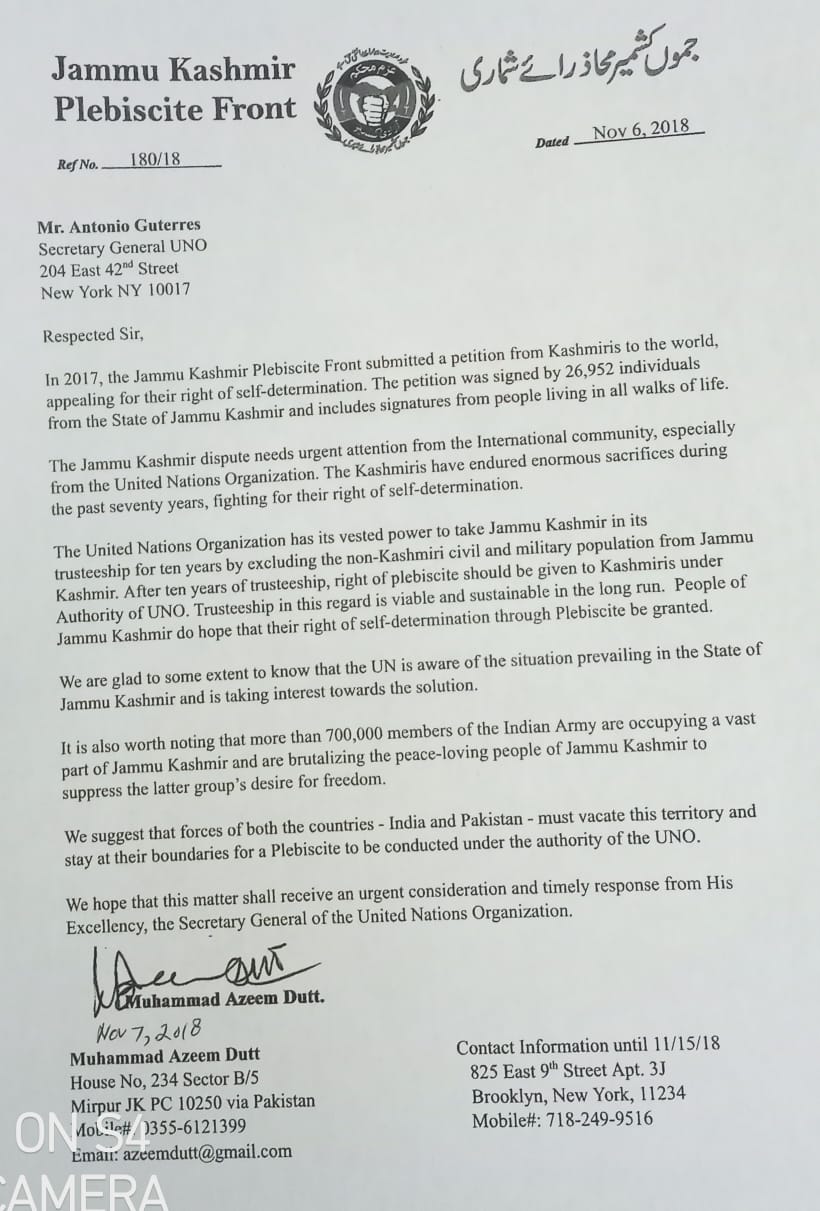
In 1965, the Awami Conference including a range of other political parties and interest groups integrated into the "Mahaaz-e-Rai-Shumaari" (Plebiscite Front). Despite attaining seniority in political stature, Sufi Zaman remained adamant in describing himself as a worker, as opposed to a leader. His other pursuits included farming (he would till his own land) and running a footwear shop in between political debates. He would abandon that too (leaving it open) whenever any member of the public requested his assistance in some public matter. Though he remained with the Plebiscite Front till death, his ideas and methodology were always different and had a unique practical shape of their own. He was fearlessly progressive and always cited the importance of public opinion. His activity involved planning, public speeches, public mobilisation and he forever remained in a constant state of thinking about the future welfare of his people.
Sufi Sahaab was the perfect example of the fearless yet oozing calm soul, vociferously addressing public concern in public and in the most evident manner possible. The bamboo stick that he carried with him wherever he went would send a shudder down the spine of many a representative of the powers-that-be. In court, he always made it clear that the judiciary never interpreted the constitution, they were always immersed in the ideology of convenience. At his Awami Boot House, he always knew that members of clandestine agencies - operating from across the road - were monitoring who and what was being said at his version of Speaker's Corner. Sufi Zaman would talk so loud as to ensure their attention and castigate the authorities for their injustices. During the Mangla Dam Revolt, he was considered a serious enough threat that they kept track of his every movement, anxious that his planning and speeches may cause irremediable damage.
Maintaining a simple and forthright life till the end, he lived a dream. Public appreciation was captured in possibly the largest funeral procession of the time. The concern people like Sufi Muhammad Zaman espoused is being felt every day as our economy lies stunted for want of electricity (amongst many other issues). We're constantly having to suffer for want of something we have in abundance, yet can't access.
* There is some ambiguity over the exact year of formation. It is either 1951 or 1952.
....
Author is a writer, broadcaster and activist working for civil society development in Pakistani administered Kashmir and can be mailed at sahaafi@gmail.com.
This article was first published in Rising Kashmir (a Srinagar-based English daily) on the 11th of May 2011.
....