Visitors

Showing posts with label PM AJK. Show all posts

Wednesday, 27 May 2026

Daily Diary (DD) - Day 147 of 2026

0504hrs:

On this day of Eid we (3 of my co-citizens including my son and I) find ourselves waking up in Bagh rather than our respective homes in Sehnsa, Panjera & Khuiratta. A meeting with the incumbent 'prime minister' of AJK - that should have taken place when we were a matter of a few feet away in Muzaffarabad yesterday - has to be happen at least 140 kilometres away in the 'PM' s home village of Palangi (Mumtazabad) today. The distance from home in Sehnsa is another 140 or so kilometres away, where I should be with the rest of my family, as the PM is with his family.

This is just one more example of why there is almost zero governance in this territory. I have to meet him as I want to save lives in this utterly peaceful rights movement, that began just over 3 years ago and is swelling towards a genuinely free government (free from outside interference and equally responsible along with its citizens). 

Here's the interview (courtesy Awam ki Awaz):


I'll re-produce the text note introducing this video, as follows:

Seeking the public stance of #PMAJK at his home village #DharraRajgan #Palangi #Mumtazabad #Haveli on Eid day (Wednesday 27 May 2026).

1) Maintaining #Peace in the territory at all cost. 

Bringing all internal elements (legal title holders as opposed to claimants) onboard to ensure no further deaths occur in #AJK in the context of #RightsMovementAJK , by adopting a foolproof  internal #Security mechanism, without external interference. 

2) Introducing financial #Transparency in all matters of public interest, particularly related to 'public representatives' in all shapes & forms. 

Proceeding towards independent research, mukaalima (dialogue), inclusivity and financial transparency to make sense of where we all need to go, rather than relying on emotion, propaganda, exclusion and obfuscation to sustain the 'power' to exploit. 

JKA PUBLIC AGENCY Note: #EFBV170527052026 

....

Tuesday, 7 January 2025

Daily Diary (DD) - Day 7 of 2025

1202hrs:

About 7 hours later than intended, even though I got to sleep by c. 0100hrs. However, I couldn't wake before 1100hrs.

It took a further hour for me to remember that a diary input is waiting. 

A day waking up in Dadyaal, which is likely to be the final day of such an event, as a renter of accommodation, as I have been since 2017.

I have never wanted to leave this tehsil and city but obviously Sharda awaits me. 

....

Many have noticed the AJK PM's 'Jihad' speech in Muzaffarabad on the 5th of January 2024 (2 days ago). Dr Nazir Gilani also provides his take:

PM Azad Kashmiri’s call for Jihad – its merits

The Prime Minister of Azad Kashmir (AJK) faces a critical juncture where a shift in approach is not just necessary, but urgent for the future of Kashmir and its people. While the PM's invocation of rhetoric surrounding the ousting of Indian forces and the use of "Jihad" to achieve a free and impartial plebiscite resonates with historical and emotional sentiment, it risks misdirecting resources, alienating key international stakeholders, and undermining the very cause of self-determination for Kashmiris. 

A more prudent and effective approach would be to redirect resources towards the revival of the implementation of the United Nations (UN) template on Kashmir—an approach grounded in international law, historical resolution frameworks, and the preservation of life and democracy.

1. The Dangers of Misusing the Concept of Jihad

The PM's call to invoke "Jihad" in Kashmir is a sentiment rooted in resistance against occupation, yet it risks being distorted in contemporary geopolitics. The term "Jihad" has been co-opted by various actors over the years to justify terrorism, a label that has deeply hurt the legitimate struggle of Kashmiris for self-determination. Today, the environment around Kashmir is one where the term "Jihad" has become associated with violence and extremism in the eyes of the international community. It is critical to recognize that such rhetoric can delegitimize the Kashmiris' legitimate struggle for autonomy, undermining their cause rather than advancing it.

Furthermore, Kashmir has already lost a generation in its quest for freedom. With decades of conflict, the death toll in Kashmir has been staggeringly high, a reality that should not be ignored. The loss of life, alongside the resulting psychological and social scars, means that Kashmir’s very future is at risk. The death of a generation is tantamount to the death of self-determination. In this context, the PM should prioritize saving lives, preserving the region’s future, and ensuring that Kashmiris live to see the realization of their right to self-determination, not through further loss but through diplomatic and legal avenues.

2. The Need for a Return to the UN Template

The PM's rhetoric on Jihad diverts attention away from the legal and political pathways already in place to address the Kashmir dispute. Since the inception of the Kashmir issue in 1947, the UN has laid out a framework—embodied in the resolutions of 13 August 1948 and 5 January 1949—that provides a clear path for the resolution of the Kashmir dispute, specifically through a free and impartial plebiscite under UN supervision. These resolutions have been endorsed by multiple international parties, including France, which has reaffirmed the necessity for both parties to return to these resolutions, and in cases of failure, to submit the issue to the International Court of Justice (ICJ) for arbitration.

The UN template on Kashmir provides a legitimate, peaceful, and internationally recognized path to self-determination. For the PM of Azad Kashmir, this template offers a foundation on which to build a future of peace, stability, and justice. Rather than pursuing futile and potentially destructive actions, the PM should focus on reviving and aligning with the UN framework, which already provides a diplomatic path for resolution. This is not only the legal framework but the one that the international community is most likely to support, including Pakistan, which is a member of the UN and a party to the Kashmir dispute.

3. Preserving Life, Preserving Self-Determination

The idea of "preserving number through preserving life" is paramount in the Kashmir context. Every life lost in Kashmir reduces the region's ability to advocate for a future of peace and self-determination. The right to self-determination, as recognized by the UN, must be pursued in ways that protect and value the lives of those involved. The PM’s focus should be on building a constitutional framework within Azad Kashmir that supports the aspirations of the Kashmiri people for self-determination through peaceful means. This framework should work in close collaboration with civil society and the international community to ensure the full implementation of the UN’s template for Kashmir.

4. The Legal and Constitutional Imperative

The PM must also address the fact that the AJK government has historically fallen short in terms of its legal and constitutional obligations to uphold the UN's resolutions. Notably, sections 8 and 11 of the 1970 Act and the 1974 Constitutional Act of AJK, as well as a 1999 judgment by the AJK High Court, emphasize the importance of the UN resolutions as the guiding framework for Kashmir’s future. However, there has been little indication that the AJK government has made any substantial effort to implement these resolutions or to advocate for the lawful entry and exit of its citizens as outlined in UN Security Council Resolution 47.

The PM must now direct the government’s resources toward ensuring full compliance with these international legal frameworks. This could include seeking legal expertise, pushing for more effective diplomacy, and working with Pakistan to ensure that AJK adheres to its international obligations. It could also involve creating a constitutional framework that not only supports the aspirations of the people of Kashmir but also works in concert with international law, helping the region to regain its credibility on the global stage.

5. Collaboration with Pakistan and the International Community

Pakistan, as a key party to the Kashmir dispute, should be mobilized to assist the AJK government in ensuring that international legal frameworks and UN resolutions are honoured. Given Pakistan's position as a UN member state, it has the political leverage and international standing to facilitate a resolution that is in the best interests of the Kashmiri people. However, this requires a shift in focus from militant rhetoric to diplomatic engagement. By reorienting efforts to revive the UN framework, the PM can work with Pakistan and the international community to ensure that Kashmir’s future is shaped through legal and diplomatic means, not through violence or political grandstanding.

Conclusion

The PM of Azad Kashmir must redirect the government’s resources and efforts from militant rhetoric and forceful calls to action towards the practical implementation of the UN template for Kashmir. The international community, including Pakistan, stands ready to assist, but only if the cause is pursued within the legal and peaceful frameworks already established by the UN. Preserving life in Kashmir, ensuring the dignity of its people, and revitalizing the pursuit of self-determination under the UN’s framework are the most viable paths forward. Only through such efforts can Kashmir hope to see a peaceful, just, and lasting resolution to its long-standing plight.

Dr. Syed Nazir Gilani

President JKCHR

07.01.2025

One may comment directly on Dr Nazir Gilani's post on Facebook here

....

Today's vlog on Facebook Live:


The people of #AJK are very warm, kind, hospitable & attentive. Though this trait is common & abundant, it is primarily found in accidental, coincidental, occasional or temporary conditions. 

This behaviour is not constant, choreographed, long-term or institutionally minded. 
This is not how a country or government can successfully operate. 

We need to cultivate a new approach in our people for better resource allocation and systematic efficiency. 

What we need and what our public is struggling to understand and even identify:

1) Population Census > Public Opinion 
By clarifying the people's 'Right to Rule. 

2) Political representation 
Marking out constituencies with roughly equal weightage of voter population, with political representatives who can abide by the will of the people as clarified in 1).

3) Citizen-State Contract
Technical & constitutional requirements for governance & statecraft to ensure transparency, inclusivity, meritocracy & accountability. 

4) A functioning government in AJK
It will immediately change its initials from AJK to JKA, which poses no threat to anybody and improves the economic well-being of its people 100 x over.

#Conflict2Peace
#PopularSovereignty
#PublicPolicy
#1To100Economy

JKA PUBLIC AGENCY Note: #E233207012025

....

Sunday, 5 January 2025

Daily Diary (DD) - Day 5 of 2025

1037hrs:

About 5 hours and 37 minutes later than I had intended. 

It is the sleeping routine that I need to address first and foremost. I couldn't get to sleep till 0400hrs and got up at 1000hrs. It is not the quantum of sleep that is troubling me but the timing of it. Let's see how it is addressed in the following days & weeks.

....

We hope that those of our co-citizens and southerly neighbours who have some how contrived from UNCIP Resolution II (5 January 1949) that self-determination can be restricted, may take the time to read the following post and get themselves duly educated:

Hello Kashmiris

Self-Determination Day

The argument about which date — April 21, 1948 (UN Security Council Resolution 47) or January 5, 1949 (UNCIP Resolution) — could be more suitably treated as Self-Determination Day for Kashmir is interesting. The following explanation remains in the field for those who follow the UN template on Kashmir:

Key Principles:

1. Article 1(2) of the UN Charter – Equality of Peoples and Self-Determination: Article 1(2) of the UN Charter states that the purpose of the United Nations is to promote international cooperation and to develop friendly relations among nations, based on the principle of equal rights and self-determination of peoples. This means that all peoples, regardless of their political status, have the right to freely choose their political status without coercion. For Kashmir, this principle of equality of peoples and the right to self-determination is central in any UN-backed solution.

2. U.S. Statement (1948) on the Kashmir Dispute: In 1948, the United States expressed a clear stance regarding the resolution of the Kashmir issue: if India and Pakistan were to reach a resolution, it should be consistent with the UN Charter and the right of the Kashmiri people to self-determination. The U.S. emphasized that any agreement between the two countries should not violate the rights of the Kashmiri people to choose their own future through a free and fair plebiscite. If India and Pakistan could not agree on a resolution, then the UN's plan — which included a plebiscite — should prevail. This reinforces the international community's endorsement of the right of self-determination for the Kashmiri people, suggesting that the UN framework remained the default solution.
________________________________________

Analysis of the Two Resolutions:

1. UN Security Council Resolution 47 of April 21, 1948:

o Historical Context: Resolution 47 was the first significant UN Security Council resolution addressing the Kashmir dispute. It came after India brought the matter to the UN in the wake of the 1947-48 war with Pakistan. The resolution called for a ceasefire, the withdrawal of Pakistani forces, and most importantly, it called for the establishment of a free and fair plebiscite to allow the Kashmiri people to decide their political future.

o Self-Determination Under the UN Charter: Resolution 47 directly tied the Kashmir issue to the right of self-determination, as stated in Article 1(2) of the UN Charter, which guarantees that all peoples have the right to determine their political status and pursue their economic, social, and cultural development. The resolution suggested that the people of Jammu and Kashmir should be able to freely decide whether they wished to join India, Pakistan, or remain independent — a decision that reflects the principle of equality of peoples and self-determination.

o Political Significance: The Resolution of April 21, 1948, was a pivotal moment for Kashmiri political groups, especially those advocating for self-determination, as it was the UN's first formal acknowledgment of the Kashmiri people's right to decide their future. This resolution set the stage for the plebiscite process, which would give the people of Kashmir the power to determine their political destiny in a manner consistent with the UN Charter's provisions for self-determination.

o Self-Determination Day Argument: For those advocating for self-determination, Resolution 47 (April 21, 1948) could be the most appropriate "Self-Determination Day" because it was the moment when the UN explicitly connected the Kashmir issue to the international principle of self-determination. This was the first official statement that endorsed the right of the Kashmiri people to choose their political future, making it a key date for those seeking to preserve and uphold this principle.

2. UNCIP Resolution of January 5, 1949:

o Historical Context: On January 5, 1949, the UN Commission for India and Pakistan (UNCIP) issued a resolution that focused on establishing the Ceasefire Line (later known as the Line of Control, or LoC) and laid out the conditions necessary for a plebiscite to take place. The resolution reaffirmed the necessity of a free and fair plebiscite but primarily focused on the administrative and security conditions required to hold such a plebiscite.

o Self-Determination Under the UN Charter: The January 5 resolution reaffirmed the principle of self-determination in the sense that it provided a pathway for Kashmiris to express their will through the plebiscite, but it was more procedural. It did not bring forward any new principles related to the right of self-determination beyond what had already been outlined in Resolution 47.

o Political Significance: The Resolution of January 5, 1949 represented a step toward practical implementation of the UN plan for a plebiscite, but it didn’t change the fundamental international recognition of Kashmir’s right to self-determination as outlined in the earlier resolutions. The political significance of this date lies more in institutionalizing the framework for holding the plebiscite than in affirming new principles of self-determination.

o Self-Determination Day Argument: While the January 5, 1949 resolution was important for its administrative decisions regarding the plebiscite, it did not carry the same weight as Resolution 47 in terms of reaffirming the right of the Kashmiri people to determine their future. Therefore, from the perspective of self-determination, it is less significant in terms of marking a moment of international recognition of this right.
________________________________________

Integrating U.S. Statement and the Principle of Self-Determination:

• The U.S. statement from 1948 explicitly aligned itself with the right of self-determination as enshrined in the UN Charter. The statement indicated that any resolution of the Kashmir dispute, whether reached through bilateral negotiations or otherwise, must be consistent with the principles of the UN Charter, including the right of the Kashmiri people to choose their political future. This reaffirmed the view that self-determination was non-negotiable and that any attempt to resolve the dispute must respect the right of the people of Kashmir to decide their future through a plebiscite.

• In this context, Resolution 47 (April 21, 1948) stands out because it was the first international recognition of Kashmir's self-determination, echoing the principle of equality of peoples under Article 1(2) of the UN Charter. The U.S. statement aligns with this resolution, emphasizing that if India and Pakistan could not resolve the issue bilaterally, the UN's framework, including the plebiscite, should prevail. This underscores the continuing legitimacy of the self-determination process envisioned by the UN.
________________________________________

Conclusion:

• April 21, 1948 (UN Security Council Resolution 47) is the more appropriate "Self-Determination Day" for Kashmir, as it marks the first formal recognition of the Kashmiri people's right to self-determination under the UN Charter. It is consistent with the principle of equality of peoples in Article 1(2) and was endorsed by the U.S. statement emphasizing that any solution must respect this right. This resolution directly linked the Kashmir issue to the right of the people of Kashmir to determine their own future through a plebiscite, thus making it a foundational date in the pursuit of self-determination.

• The January 5, 1949 UNCIP resolution, while important for the implementation details of the plebiscite, does not carry the same foundational significance in affirming the right of self-determination as Resolution 47. Therefore, April 21, 1948, aligns more closely with the principles of self-determination and would be the preferred date for those advocating for Kashmir's right to self-determination as outlined in the UN Charter.

Dr. Syed Nazir Gilani

President JKCHR
 
05.01.2025

One may comment directly on Dr Nazir Gilani's post on Facebook here

....

A great furore has emerged over the AJK 'prime minister' Choudhary Anwaar ul Haque's public statement about facilitating 'Jihad' in Kashmir (Valley) once again, earlier today in Muzaffarabad:

I'm posting the video clip here directly for reference:


Perhaps the best riposte came from Raja Amjad Ali Khan (prominent advocate of Muzaffarabad) who wrote the following:


Translated thus: (I have added words in brackets for clarity and context, especially for those people not so aware of the machinations of the AJK 'Government')  

The real (actual) announcement is this:

If the creation's largest (ministerial) cabinet in proportion to its (territory's) population.....The (world's) largest bureaucracy...An army of government employees (whose employment has been) facilitated by bribes and (political) 'recommendations'...Conducting 'pleasure trips' throughout the world despite the territory's responsibility for foreign affairs (policy) being handed over (surrendered) to the Government of Pakistan...If this "State" (continues) to exist despite (the above-mentioned) enjoying themselves in all manner from the public exchequer (purse), then we must retain these "facilities" for our children, even if - instead of half - 90% of our population have to migrate for the purpose of seeking livelihood....Even if the natural resources of this territory are completely destroyed....Even if those who can't flee (from here) continue dying a painful death in the absence of (medical) treatment.....we will continue to stand by our mission (motto to exploit)...  

End of translation....

....
  
This evening's statement on Facebook Live:


I repeat from yesterday, a day before that, a day before that and a day before that:
We need to design, agree and implement a #CitizenStateContract as the people of #AJK . 
Otherwise, we have no grounds to negotiate or seek authenticity from the rest of #JKA , our neighbours #Afghanistan #China #India & #Pakistan or the rest of the world. 

I have also announced today, that if at least 1,000 of my co-citizens do not financially co-operate with me (provide a 10 year fixed deposit of the equivalent of £1,000 UK pounds, payable in installments over a period of one year) then on the 31st of December 2025, I will resign from all my public interest activities in AJK. 

#Conflict2Peace
#PopularSovereignty
#PublicPolicy
#1To100Economy

JKA PUBLIC AGENCY Note: #E230005012025

....

Tuesday, 30 April 2024

Daily Diary (DD) - Day 121 of 2024

1146hrs:

Continuing on the journey of taking the camel laden with precious wisdom through the eye of a needle, we immerse ourselves further in human/data management so that we can manage the most strategically contested water, soil & waste in the world.

The financial resources needed to do so are modest but must fairly & equitably apply to each and every citizen of the territory of AJK. 

Indigenous Public to Public Interaction:
1) Generate Ideas >
2) Struggle for those Ideas >
3) Recognition of those Ideas >
4) Investment in those Ideas >

Laying conditions & possibilities for achieving genuine public policy goals in AJK.

....

This is the latest example of incendiary rhetoric committed by a 'loyalist'* politician in #AJK 

#ChoudharyAnwaarulHaque


1) You should no longer use #India as a scare-mongering tactic to divert attention away from your ineligibility & incapability to govern this territory.

Do not hide behind India.

2) 'Aini haath' (constitutional fist) 
There was a lot of aggression in that expression and you have spun a constitutional trap for yourself. You cannot claim the mandate of the people if you have 'procured' your mantle as 'prime minister of AJK' #PMAJK through the assistance of another country. You have 'democratically disqualified' yourself from claiming that title. 

Your arguments against India are the arguments of #Pakistan 

We - the people/public - have our own arguments against India. It would be foolish of us to club our arguments with yours.

You are threatening to deprive us (the people/public) of our democratic rights through aggression and fairy tales about forefather's commitments etc.

You are threatening the geo-political neutrality of this territory and thus you are threatening the peace of this territory.

You will have to answer the 4 questions wanting of examination in reference to your 'foundational document' #24Oct1947 **

1) What happened to the people's reference ("the right of free self-government" as written in the declaration) post that date?
2) What happened to "entertain(ing) sentiments of the utmost friendliness and goodwill towards" our neighbouring dominions (now countries) of India and Pakistan?
3) What happened to "...securing to the people, including Muslims, Hindus and Sikhs" that "right of free self-government"?
4) When are you going to surrender to the 'Will of the People' as indicatively measured by 'Citizen Public Opinion Survey AJK - Report 2017' *** and currently being clinically measured by #AJKReferendum2023 **** ?

You can no longer enforce #IdeologicalApartheid in this territory from the barrel of a neighbour's gun.

You cannot use the licence 'of the people' against 'the people'.

#ConstitutionalEvolutionAJK
#PublicPolicyAJK 
#Conflict2PeaceAJK
#WhiteFlagsAJK

References:

* - https://tanveerandkashmir.blogspot.com/2011/06/of-nationalists-and-loyalists.html 

** -
https://tanveerandkashmir.blogspot.com/2020/08/daily-diary-dd-day-218-of-2020.html

*** -
https://drive.google.com/file/d/0B8NvBPqFcnTVeXRmMjhhdmpjUDg/view

**** -
https://tanveerandkashmir.blogspot.com/2023/05/daily-diary-dd-day-143-of-2023.html

JKA PUBLIC AGENCY Note: #E181830042024

....

Thursday, 5 October 2023

Daily Diary (DD) - Day 278 of 2023

0900hrs:

Waking up to a very fresh and very green Palangi in Mumtazabad, the 'janam bhoomi' (Fatherland) of Raja Mumtaz Hussain Rathore, who served as prime minister of AJK between 1990 and 1991.

.... 

Monday, 5 June 2023

Daily Diary (DD) - Day 156 of 2023

0921hrs:

In green pastures near the LOC at Goi:


....

As anticipated, the Government of AJK and the Government of Pakistan are playing it sly, in reference to absorbing this territory into Pakistan without the all important people's reference. Here's a letter written to the prime minister of AJK, written by the founder of the Centre For Jammu Kashmir Public Diplomacy Qauyyum Raja, urging the former to make the content of the recent 15th amendment public. The fact that the AJK legislative assembly is not making this amendment public speaks volumes about the intent of both the Pakistani State and its political proxy in this territory:


....

Here's our eighth TikTok offering:

@ajkpublicagency #AJKReferendum2023#AJKReferendum2023#AJKReferendum2023 - Day 14 - #Dhanwa #Goi #Kotli #AJK - ZK #05062023 ♬ original sound - Tanveer Ahmed

....

And our fifth YouTube offering:

.... 

Tuesday, 4 January 2022

Daily Diary (DD) - Day 4 of 2022

1746hrs:

Fighting with time to make sense of diverse opinion and strategy which bombards me on a daily basis. Creating consensus is not elusive though.

...... 

JKLF (Toqeer faction/group) are into their 59th day of a sit-in protest in Kotli, for the return of their confiscated literature by Pakistan's clandestine agencies. They conducted a novel protest today by symbolically handcuffing themselves, to offer the visiting prime minister of AJK Sardar Abdul Qayoom 'Niazi' some food for thought. After all, the latter is 'officially' the head of State of the 'free' part of Jammu Kashmir & Allied areas.


.......

The following is also a novel manner of attracting attention to the child victims of war, namely 'Red to Green' Kashmir. This annual activity on the 4th of January began a few years ago and initially received some patronage from the AJK government, before paranoia on behalf of the Pakistani State set in, as it usually does with any well-intentioned initiative in AJK. Meanwhile, the commitment of local activists - despite the icy temperatures and rain - may be witnessed:


.......

Wednesday, 5 August 2020

Daily Diary (DD) - Day 218 of 2020

1500hrs:

We are certain that whatever we do today in terms of condemning our 2 southerly neighbours will be insignificant compared to what we need to do over the coming months to enable sanity to prevail in global geopolitics. Here's a sample of what we conducted today:


.....

I'm inclined to estimate that genuine pressure on the British government is slowly mounting in reference to their unfulfilled responsibilities in Jammu Kashmir & Allied. Here's a typical non committal response by the British Foreign & Commonwealth Office to a letter by the Scottish activist Claire Bidwell:


This has generated a discussion at the following FB link:


https://www.facebook.com/groups/worldkashmirteaparty/permalink/1098076913922846/


This is a particular comment thread that includes my comment:


Sagir Ahmed:


Tanveer Ahmed commented: As the unresolved status of Jammu Kashmir & Allied is a political problem created by the British Empire, all political prisoners throughout the territory are the moral and legal responsibility of the UK government. They should no longer be allowed to continue 'passing the buck' to India and Pakistan, both countries which came into being precisely according to the British Empire's satisfaction. They also not only facilitated the entry of Indian and Pakistan troops into JKA but stabilised their presence too. In 2020, it is no longer clever of them to abdicate responsibility. Nature has its own way of biting back.


Claire Bidwell:


It does indeed and I will keep biting them here until I get deeper answers!


Soraya Boyd:


Sagir salaams. Britain is exceptionally good in fact it really does excel at it: it creates a problem, makes a mess and leaves with great pomp and circumstance. A very very British characteristic. Britain has done this many times over. Just a few examples: Palestine and Kashmir. Of course our responsibility as Brits is to hold our gov to account. We do and we will continue to. Rest assured. Undoubtedly politicians by and large are very good at postponing the inevitable but FREEDOM WILL BE YOURS brother.

......

Meanwhile, pressure is also mounting on the Pakistani government to stop prolonging this needless conflict by pursuing a territorial dispute with India. According to the prime minister of AJK, this is what negates the genuine pursuit of the right to self determination by the people of Jammu Kashmir & Allied:


I understand that I will have to transcribe this video into Urdu text and then translate it into English:


Note:

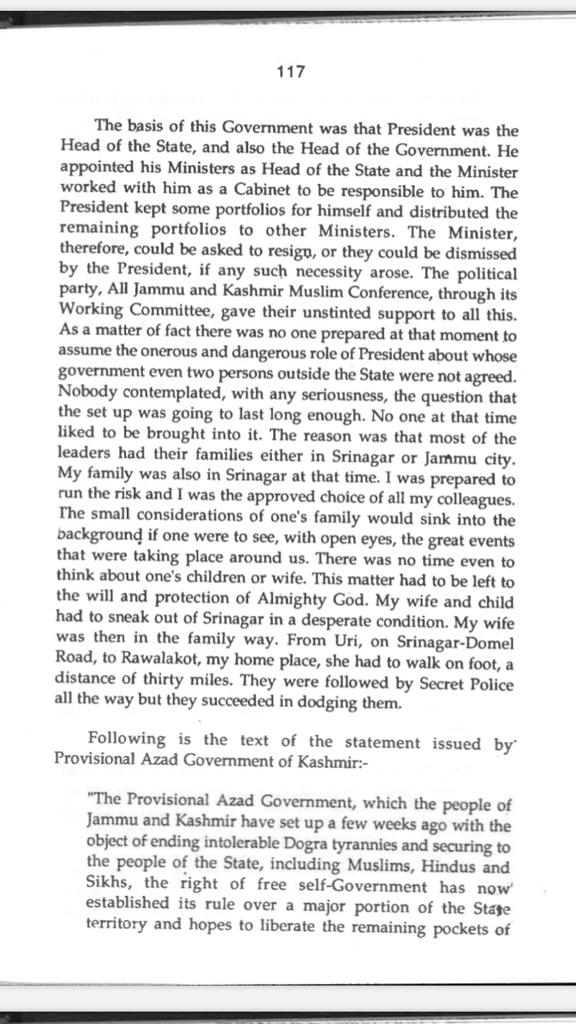
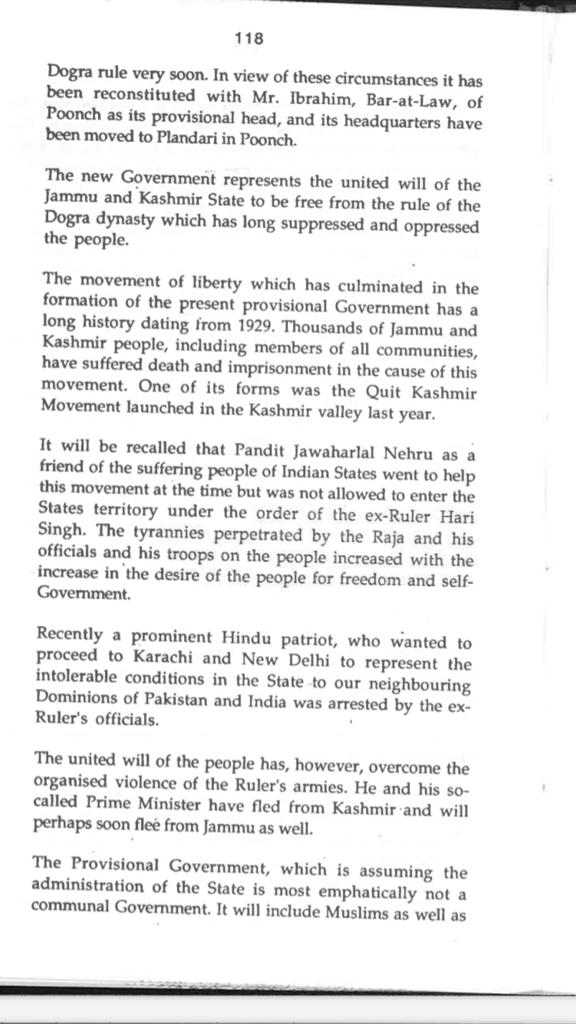
The basis of the current AJK government finds its origins in the 24 October 1947 provisional government declaration. It is reproduced here directly from its founding president Sardar Ibrahim Khan's book, 'Kashmir Saga':

Page 117

Page 118

Page 119

We also have an Urdu version of the declaration available for your convenience:

Page 1 of 2

Page 2 of 2

....

Friday, 17 July 2020

Daily Diary (DD) - Day 199 of 2020

1424hrs:

So it has become apparent that the AJK Assembly has plucked up the courage to reject Pakistan's proposal (read order) for the 14th Amendment which would have reversed most of the gains achieved in the 13th Amendment. Everything is still under a cloud which is true to form of the Pakistani State, which has relied on obfuscation as its most potent weapon since 1947.

One needs to go through the proposal - which cannot be guaranteed to be the actual version - not least because it gives an impression that it has been proposed by the AJK Assembly itself when in fact it came from the direction of Pakistan's federation, apparently on the 20th of June this year. Here's a copy of what is publicly available:

Page 1 of 10

Page 2 of 10

Page 3 of 10

Page 4 of 10

Page 5 of 10

Page 6 of 10

Page 7 of 10

Page 8 of 10

Page 9 of 10

Page 10 of 10

The rejection of the above proposal (or direction) by the Pakistani State to amend the constitutional framework (which is in fact not constitutional as it has no local input and was imposed in 1974) operating in AJK was rejected unanimously by the AJK Assembly. Here's a press release in Urdu to that effect. It was made public yesterday but has a time stamp of the day before yesterday:


As it is in Urdu, public interest would dictate that I translate it into English for the benefit of our English speaking public as well as the world at large.

Thus:


(The) Free Government of the State of Jammu & Kashmir

(Press Release)

An extraordinary convention of the Azad Jammu & Kashmir (AJK) cabinet took place on the 15th of July 2020, presided over by Esquire Prime Minister - (of the) Free Government of the State of Jammu & Kashmir - in the cabinet committee room (Prime Minister's Secretariat) Muzaffarabad. Also present in the meeting were (representatives of) the Department of Law and the Department of Kashmir Affairs. The documentation received from the Government of Pakistan, in reference to the (proposed) constitutional amendment on the 22nd of June, was discussed and reflected on at length. The cabinet made the following decisions on the subject of the proposed documentation:

i) 
The cabinet has not completely agreed with the constitutional amendment documentation.

ii) 
It is the collectively agreed opinion of the cabinet that the State of Jammu and Kashmir has an ideological relationship with the motherland of Pakistan, which is a manifestation of the undying aspirations of the Kashmiri people. This is not merely the ownership of an individual, party or government but in fact the collective ownership of the inhabitants of the State (of Jammu & Kashmir), on both sides (of the divide). This bond is completely in accord with the vision of the honourable father of the nation Muhammad Ali Jinnah, the founder of Pakistan.

iii) 
The cabinet has further expressed that on the basis of the action taken on the 5th of August 2019 by the Indian government; the accepted international status of the Kashmir issue, the will of the State's people and their fundamental rights have been violated. In order to achieve its vulgar aims, the Indian government has taken this step in order to change the demography (of the territory under their control), which is in total contradiction of the United Nations Security Council resolutions. In this context, for the purpose of translating the aspirations of the inhabitants of the State of Jammu & Kashmir - on either side (of the divide) - it is requested that steps be taken via mutual consultation to further empower the government of Azad Kashmir.

iv) 
The cabinet has also expressed the opinion that constitutional matters via mutual consultation can only be decided in accordance with public aspirations and the intent described in article 257 of the Pakistani constitution. For this, mutual consultation is needed at the highest level (of Inter-State relations.

v)
The cabinet through collective agreement has expressed their full and complete satisfaction in the leadership of Esquire Raja Muhammad Farooq Haider Khan, the prime minister of the free government of the State of Jammu & Kashmir.

(Signature of Raja Wasim)

Press Secretary of the prime minister 

.....End of translation of Urdu document above

.....

I was invited to participate in the following programme which references a novel way of tackling issues of public interest. From cleaning (refuse disposal) to telecommunications, roads and the political leadership crisis in AJK:


.......

Tuesday, 5 May 2020

Daily Diary (DD) - Day 126 of 2020

2244hrs:

A 2:41 minute audio message in Urdu was sent to the prime minister of AJK today.


English translation followed by transcription in Urdu:

Greetings Respected Farooq Sahaab. The narrative (which we are referring to) is one that your 49 members of the (AJK) Assembly cannot espouse, due to certain compulsions or enticement that they've drawn themselves into and that has been the story - on aggregate - for the past 73 years.

We affirm that the transitional process - through the means by which - the system changed here in 1947, did not emanate through due process and whatever changes have emerged were conducted by the representatives of the British Crown. There was a proviso* that the people would be consulted (referred to) in the aftermath of whatever commotion took place in October 1947. Indeed, in that very letter in response to (Maharaja Hari Singh's appeal for military assistance) written by the then Governor General of India Lord Mountbatten.

This should also be kept in mind that the system of governance in India was (effectively) administered by the British up to 1950 while in Pakistan they remained till 1956. Thus, all developments occurred under British supervision. The Indian Independence Act and all that happened of consequence were under circumstances whereby the whole system of governance and administration viz. the economy, defence etc. remained under their control. 

So Indian Governor General Mountbatten in response to the Maharaja attached a proviso that when peace is restored then we will refer to the people (to determine their future). This is our first point of reference.

We don't need to leap forward to the United Nations. This issue was created by the British Empire and the solution leaves some parts of the key in London whilst the remaining parts are here, on the ground.

Thus, if we want a solution then that requires an initiative here (on the ground). In that manner, we will appear forthright in our approach to the world and hence be effective. What would emerge as our narrative to the world requires an internal process.

I think these words should suffice. This will be our second (Assembly) session. Our inaugural session was conducted on Sunday the 9th of February outside the Assembly Secretariat in Muzaffarabad. I'll send you the video link here...thank you very much.

Urdu transcription:

Jee Aslkm mohtaram Farooq Sb..uhm wo bayaaniya jo aap ke unchaas (49) jo Assembly memberaan hay wo bayaaniya...uhm jo kisi majboori ke tehat ya kisi laalach ke tehet...uhm...wo nahi bhol saktey aur nahi wo bol rahey hain

..uhm..pichley majmooi taur par 73 saal se...teek hay..jo process hay jis ke zariye se yaha ka nizaam change huwa 1947 me..hum kehtey hay ke wo logo ke..kisi due process ke zariye se nahi huwa...aur jo bhi changes ayi hain humey

...uhm..Malika e Britannia ki ..uhm.....ke namaaindo ne kaha ji ke logo se poocha jayega....jo bhi halla gulla huwa October 1947 me to...us me...uhm..jo letter ...uhm..Lord Mountbatten jo basically us waqt Governor General they India ke

...aur ye bhi zehn me rehna chahiye ke India ke andar jo nizaam hay wo 1950 tak wo angraiz hi chalaa they rahey aur..1956 tak wo Pakistan me wo chalaatey rahey...to ye angraizo ki hi..uhm...nigraani me..un ke supervision me hi

...zaahir hay Indian Independence Act bana..aur jo bhi cheezey huwi hay..saara nizaam aur insiraam...eh uhm...economy, defence har cheez unhi ke control me thi..to Mountbatten ne

...Governor General ne Maharaja ko jawaab detey huwey ye likha tha ke..jab aman o amaan qaim hojayega..uhm..to hum logo se poochengey to...uhm..ye hamaara pehla point of reference hay

..humey UN me chalang lagaani ki zaroorat nahi hay......teek hay..masla Britannia ne banaaya aur masla ka hal jo hay....us ki jo chaabi ke kuch hissey hain wo London me hi hain..baaqi hissey yaha pe hi hain..ground par hi hain

...aur agar hal aap ko chahiye to ground se hi koi initiative hoga to wo cheezey dunya me paidaar aur baqi jo effectiveness hay wo mu'assar banaaney ke liye jo aap ka narrative hay dunya ke saamney us ke liye aap ko aik androona process chahiye

..mere khyaal se ye alfaaz kaafi honey chahiye...ye doosra ijlaas hay..pehla ijlaas 9 February itwaar.....itwaar 9 February..ibtadai ijlaas Assembly Secretariat Muzaffarabad ke baahir hi huwa tha..us ka me video link aap ko yaha bhejh deta hoo..bahut bahut shukrya       

Reference:

Proviso*
Victoria Schofield - ‘Kashmir in Conflict – India, Pakistan and the Unending War’ (I.B. Tauris - London & New York - 2000 & 2003

.......

Monday, 16 December 2019

Daily Diary (DD) - Day 350 of 2019

2334hrs:

I have been driving flat out since I ended my current journey to Muzaffarabad on Day 26 at 1400hrs....changed vehicle in Sehnsa but kept driving......just reached Dadyaal less than 5 minutes ago. 


Such is the magnet of a 24 hour routine!


......


(Update on 17/12/19 at1758hrs):


The AJK Prime Minister's Secretariat:


'The People's Assembly - AJK Public Document' was handed over to Senior Special Secretary Raashid Hanif of Mirpur at the Assembly Secretariat and an acknowledgement received:


People's Assembly AJK - Public Document Copy for AJK PM

Document Acknowledgement Received

........

Daily Diary (DD) - Day 219 of 2026

0608hrs: I continue to stretch my energy levels at the age of 54, in order to bring you on-the-ground details and/or analysis of this pathet...